Municipalities, as cemetery managers, often struggle to keep pace with the religious and cultural pluralization of society. Consequently, the Luxembourg government is looking into setting up new inter-municipal cemeteries that are to be inclusive or “interconfessional”. In 2023 the Luxembourg Ministry of Home Affairs contacted the University of Luxembourg and was interested to hear about CeMi’s Roadmap for inclusive cemeteries and crematoria in diverse societies. After the 2023 elections, despite a change in coalition, the new government went ahead with this plan and commissioned our one-year research project which we decided to call CiSup (Cimetières supraconfessionnels).
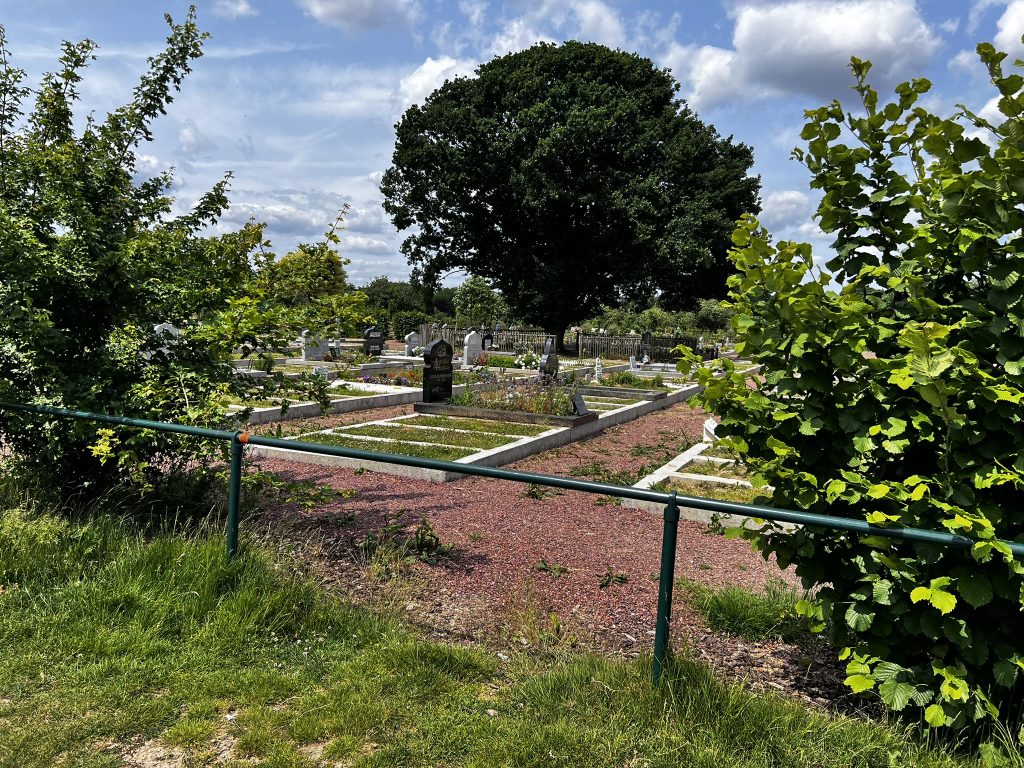
CiSup builds on CeMi and asks more concretely how to implement the “contact zone” cemeteries constitute. Cathy Collard, a former Masters student in history, was recruited to conduct this work. She reflects here on how this research changed the way she thinks about social justice and the hidden world of burial policies and practices:
“Before starting the CiSup project, I had not questioned the layout or the design of Luxembourgish cemeteries, nor had I ever thought about how much they are shaped by Luxembourg’s Catholic past. For me, symbols like the cross were inherently linked to death. However, once I began studying the literature, I quickly discovered that this normative view was one of the main issues with cemeteries in Luxembourg and abroad. Equally striking was learning that members of several religious communities are still unable to fully carry out their funerary practices because of the existing legal framework. Additionally, during my research about cemeteries abroad and my visits to some of them, I realized that they can be far more dynamic and expressive than those in Luxembourg. Offers such as “free fields,” which allow for a more personal expression of grief, or initiatives like cafés, flower shops, volunteer programs, etc., made me see cemeteries as places that can come alive in a sense. Seeing cemeteries as shared spaces that allow encounters between different communities, or even as quiet recreational areas similar to parks, was therefore very inspiring.
Speaking to the religious leaders and representatives of religious and worldview communities was equally enlightening. Our conversations were very rewarding – while death is a sensitive topic, most representatives spoke openly about it, sharing anecdotes or even humorous stories that were very touching. Speaking to a variety of stakeholders, I found that many shared similar thoughts about death and funerary provisions, and also showed genuine interest in the needs of other communities. In addition, I was struck by how distressing certain laws and informal rules surrounding funerary practices can be. Hearing stories about the real-life implications of these regulations gave me a perspective that was very eye-opening and moving. Finally, I was also surprised to realise how Luxembourg treats death-related matters: dying remains a kind of taboo topic for many, yet some religious communities embrace death differently, mourning their dead much more openly. CiSup certainly changed my perspective on these matters. One year ago, I thought of dying as something dark that should be talked about as little as possible. Now, after seeing the diverse and colorful expressions of grief in cemeteries abroad, and after hearing perspectives that are not as negative, I have come to accept it as a natural topic – one that should be spoken about much more openly in society at large.”
A new type of cemetery for “all faith and none” – adapted to contemporary needs and expectations – would encourage this change of perspective. The aim of implementing such inclusive cemeteries is for them to function as contact zones to gain better understanding of different worldviews and to openly discuss material, legal and ecological issues at stake.